tisdag 30 augusti 2022

Liberalism in Dark Fantasy Ages

I'm currently reading ”Liberalism in Dark Times” by Georgetown univerity scholar Joshua Cherniss. The book describes how a number of liberally inclined, twentieth century thinkers, including Albert Camus and Isaiah Berlin, tried to deal with anti-liberalism and totalitarism, mainly nazism and Soviet communism.

The main concern in the book is how to adress ruthlessness and cruelty without becoming so ruthless yourself that you loose your liberal essence and soul. That is: how do I fight, stop and if necessary kill bad guys while not staining my own hands, becoming as bad as they are. Liberalism should after all be based on law, individual rights, tolerance, acceptance of diversity and freedom of speech. These questions are very urgent also today, as democratic societies wrestle with an openly aggressive and repressive Russia as well as with internal, populistic lies and organized crime.

There are however no simple solutions, as there seldom are in non-totalitarian politics. Cherniss leans towards liberalism founded in ethos, that is a personal conviction of liberal norms, rather than having liberalism rest on ideology. The problem with the latter is that it often slips into expedience; ”the end justifying the means”. You've been brutalized, so you're justified to be brutal in turn. In Star Wars, you would turn to ”the dark side of the force”. Instead Cherniss wants you to retain your soul and resist the temptation to quick and dirty fixes. This is not simple, but perhaps the only way. I wrote a blog post (in Swedish) on a simliar subject: that extreme positions tend to get stuck and inflexible, while interesting development only takes place in the instable balance point between them. I compared this position to the equivalence point in chemical titration, where small changes yield major effects.

Liberalism in my fantasy writing

I'm currently working on two expansions to Free League's role-playing game Forbidden lands as well as writing a fantasy novel in the game setting that I had the pleaure of constructing. Cherniss' book has given me unexpected and useful input. In the game you meet ”The Rust Church”, a fascist religious organization. What I learned from the book is that many (not all) early Soviet communists and German nazis started out in good faith; that they solidly believed themselves working for a good cause. Being part of nonliberal movements, they however were told that their personal opinions and comforts would have to be sacrificed for the greater, common good. Indeed, the weak of stomach had to prove their loyalty by demonstrating cruelty and abscence of empathy – ”Squeamishness is the Crime” as is the title of the first chapter. Once this threshold had been overstepped, people could stand working in prison camps. I like giving my bad guys some kind of rationality rather than just being sadistic and ”bad”, so I'll probably use similar mechanisms for the Rust church. Add some historicism – the belief that your cause inevitably will prevail, and that anything implying the contrary is fake and heresy – and you're set for disaster. As Bolshevism had it: good can issue from evil.

For liberal champion, I will use the elf Mergolene from the game, advocating moderation, respect, coexistence and reasoning to fellow elves that feel justified in raiding and killing the orchs at The Eye of the Rose, a fortress once built by elves. Mergolene will probably be the protagonist of the second novel in my series. The more aggressive elves will advocate the temptations theatening fed-up liberals.

By reading and using books on history and political theory, I get the opportunity to discuss and adress current problems in our own world while writing about fantasy stuff in made-up lands.

Simply the best of two worlds!

måndag 13 juni 2022

Gudarna är döda!


Efter sju års spelande publicerade podden Vi Spelar Rollspel idag det sista avsnittet av konfluxsviten. Den femte konfluxen inträffade och kaklunen – en lika skrämmande som lysten kärleksvarelse – kom att dominera ödespunkten, frammanad för ändamålet av äventyrarna. Kaklunen hade lovat dem en värld utan gudar och sådan kommer världen att bli. Alla var inte med på noterna och manfallet blev också stort under finalen.

Om en vecka ska spelledaren Axel Widén och hans spelare tillsammans med mig spela in ett eftersnack. Sedan börjar jag och Axel att fundera över hur en fortsättning bortom konfluxen kan gestalta sig i ett helt ommöblerat Trakorien.

Spelare och spelledare i Vi spelar Rollspel har imponerat med sin kreativitet, konsekvens och sina rolltolkningar under alla dessa år. Jag är stolt över att ha fått leverera dansgolvet på vilket de dansat.

”Gud är död! Gud förblir död. Och vi har dödat honom. Hur ska vi trösta oss, vi alla mördares mördare. Det heligaste och mäktigaste världen hittills ägt har blött ihjäl under våra knivar: vem ska torka av oss blodet? Vilket vatten finns för att rena oss?”

Friedrich Nietzsche, Den glada vetenskapen


lördag 5 februari 2022

Marozias resa


Romanskrivandet löper på ganska bra för tillfället. Huvudpersonen Marozia har, jagad av rostkyrkan, hittat till Vädersten, borgruinen där den döde kung Algarod och resterna av hans här osaliga vandrar omkring sedan tiden före Blodsdimman. Broväktaren har på Merigalls förslag sökt upp den fredlöse, alderländske soldaten Rintra Avhändaren som fått uppdraget att bära bud till den döde kungen. Därmed ska Rintra visa sig värdig en plats hos rebelledaren Zertorme.

Jag har åtminstone kul!

måndag 31 januari 2022

Järnlåset


Mondefort av Terova

I natten faller regn över Järnlåset. Det regnar så kraftigt att en främmande betraktare kunde ängslas över hur låsets järn ska rosta ihop för all framtid och aldrig mer kunna öppnas. Sådana omtankar är emellertid bortkastade eftersom Järnlåset är en mur som saknar både lås och port. Muren är rest mot en bergvägg och vid dess fot börjar Ravland som en benbeströdd sluttning inne i en ravin. En människokropp som kastas utför muren hinner uppleva ytterligare sex hjärtslag innan både kropp och hjärta krossas mot stenarna nedanför. Andra tilldöms mildare förvisning från Alderland, och det enda som möjligtvis kunde rosta på Järnlåsets mur är den kran med vinsch som sänker ned dem. Oaktat straffets mildhet åläggs alla fredlösa en livslång fördrivelse. Kranen och vinschen hålls väloljade. De kommer därför inte att rosta ens i regn.

Den här natten klamrar en liten flicka vid sin fars ben på murkrönet. Hon skakar av gråt, av köld och av skräck, men hans hand stryker henne lugnt över håret.
”Marozia, har du betänkt en sak? Vi kommer att se sådant i Ravland som inte ens kungen i Brodelmarg känner till!”
Fingret pekar ut mot mörkret där det egentligen inte finns något att peka på. Vatten dryper från rockärmen liksom från mannens skägg.
”Var är mamma?” piper barnet.
Hans hand på hennes hjässa stannar för ett ögonblick, fingrarna kröks lätt som ville de bli klor ägnade att söka grepp i tillvaron, och flickan blir rädd att hon än en gång har sagt fel saker. Snart stryker faderns fingrar igen.
”Mamma kan inte följa med. Hon måste stanna med Berden och katterna, men hon lovade att komma till avsked.”

När flickan vill fråga mer, drar fadern henne intill sig, för att värma och trösta och kanske för att tysta henne. Tillsammans stirrar de från murkrönet ut i Ravlands natt. Han har tidigare stått på samma plats när han övervarat andras förvisning, det var medan han fortfarande hade en upphöjd ställning vid hovet. Även under ljusan dag och utan regn skulle inget annat än en benbeströdd bergsklyfta finnas att se långt därnere. Det vet han.

En officer från De tysta söker parets uppmärksamhet, men säger förstås inget eftersom tystnadslöftet är strängt och livslångt. Mannen håller fram ett timglas i ena handen och en pil i den andra, vilket betyder att de förvisade har samma tid på sig att lämna Järnlåsets närhet sedan de sänkts ner i Ravland, som det tar för sanden att rinna genom timglaset. När sanden förrunnit skjuter vakterna såvida de fördrivna fortfarande är inom skotthåll. Fadern har sett flera förvisade medvetet stanna och låta sig genomborras till döds hellre än att söka sig ut i det fredlösa Ravland, men det ödet är inget han planerar för sig och för dottern.

”Sänk ned oss redan nu under natten!” säger han.

Den tyste låter handen med timglaset beskriva en båge över sig och visar därmed att de dömda har rätten att vänta på soluppgången, men fadern insisterar. Officeren irriteras, eftersom männen därmed berövas den spänning i tristessen som det innebär att söka pricka flyktingarna med sina pilar. Många andra nöjen gives inte vid gränsen, men han kan inget göra – den fredlöse har varit en betydande person i Alderland och har förmodligen kontakter man vill hålla sig väl med. Fadern vet för sin del att han och dottern får mer tid på sig att att lämna Järnlåset om det är mörkt runt dem. Barnet är redan utmattat och kan därför inte springa eftersom de har varit på resa mot norr under två dygn i en obekväm fångvagn. Skulle rovjur vänta på dem därnere i klyftan så löper de istället ökad risk att skadas, men fadern, vilken under en tid tjänstgjorde som heraldisk minister, är van vid att bedöma givna alternativ och har alltid satt en heder i att fatta omedelbara beslut. Officeren nickar bistert innan han går till sina förberedelser.

fredag 31 december 2021

Sex, Soul and The order of Egression


I've recently read two books, that to my surprise and delight held unexpected similarities although they at a first glance seemed to be very unrelated:

The Soul of Sex, by Thomas Moore (1998)

and 

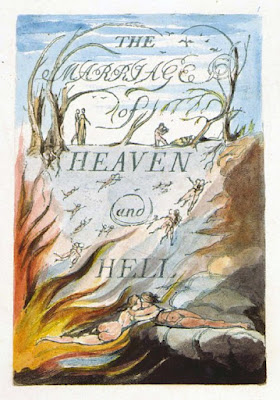
The Marriage between Heaven and Hell, by William Blake (1793)

Moore is a psychotherapist, theologian and former monk, who with his book aims to do away with the concept of soul and body being different things, one good – one bad, one elevated – the other base, etc. He suggests that we can only live a full human life if we care for both, respecting bodily pleasures while placing these in a wider context. It's a very rewarding book to read, and I especially liked Moore's historical examples (among these, I find the etymology of the word ”fascination” hilarious: it stems from ”fascinum” – penis-shaped talismans carried by the Romans.)

Sensation can not be separated from imagination. We are always living in a story, always surrounded by images, and always percieving with imagination.

Blake's book basically says the same thing, illustrated in Blake's unique style, wanting to do away with the separation of soul and body, referred to as ”reason” and ”energy”, the former represented by anemic angels and the latter by passionately roaring devils. That is, he wants the two to marry:

Man has no Body distinct from his soul; for that called Body is a portion of a Soul discerned by the five senses, the chief inlets of Soul in this age.


In Ravenland

Apart from taking a personal interest in both books, I find them useful for the Ravenland novel I'm currently writing. My protagonist is a doula of The order of Egression, a bunch of people helping the restless dead to actually die in the name of the mysterious Nightwatcher God*. Books like the two mentioned help me flesh out the egressors' beliefs and hopefully make them more plausible. The Nightwatcher is a god of transition, of passages from one stage to the next – and not only life to death. He watches over opposites and the merging of these, since they are actually considered one. As Blake puts it:

Without contraries is no progression. Attraction and repulsion, Reason and Energy, Love and Hate, are necessary to human existance.

Enantiodromia was Carl Jungs name for when one extreme flips into what seems to be its opposite, but which is actually its yin-yang-ish complement. This I learned from Moores book.

To me, Nietzsche's attraction to passion and acceptance of both body and soul – good and bad experiences, hoovers over these waters. Now, I don't agree with everything that Nietzsche says, nor with Blake, Jung or Moore, but they are all inspiring – on a personal level and especially for writing fantasy novels.

* The Nightwatcher's name in Swedish would correctly translate into ”Being the Night”, which I find far cooler.


onsdag 15 december 2021

On gender equality in Trachoria

Sandra Zurbuchen & Corina Wehinger

Sweden recently won the World championships in floorball* for both women and men. Both Swedish national teams beat their Finnish counterparts in final matches that were even and could have ended either way.

For the first time ever, two women were the referees of the men's final: Sandra Zurbuchen and Corina Wehinger from Switzerland. This may be remarkable in itself, but even more remarkable was that I didn't hear a single gender-related comment concerning the referees during or after the match, not from reporters, not from interviewed coaches nor from players. The men's final was an intense and physical match with lots of prestige, played in a packed and loud stadium in the Finnish capital Helsinki – Finland and Sweden being long-time arch enemies in this sport. Still the referees handled it superbly and professionally, even when it meant stepping in between hot players on the verge of a fist fight. They were so professional that nobody simply thought of their gender, even less commented on it.


It struck me that Sandra Z and Corina W did what I have tried to do with gender equality in Trachoria; to make it a non-issue. In Trachoria, men AND women may be generals, heroes, corrupt politicians, assassins, bosses, swine, sluts, business people etc. Favours are not given, predjudice not aired and considerations not made due to gender. This is however not based in ideology, morals or rights. People in Trachoria are not above saying nasty things or screwing each other, literally or figurately, independently of gender. I simply wanted gender equality to be a non-issue. Whether I succeeded or not in doing this is of course another thing. Comments welcome.

* FYI, The war scythes of the RhabdoRana murder league in Trachoria are modelled on floorball sticks.

https://www.lekolar.se/globalassets/inriver/resources/84104_41944.jpg?preset=mainimage

fredag 9 april 2021

Reversed archeology


This month I'm participating in no less than four interviews concerning fantasy world building. Gathering my thoughts on the subject, it struck me that I practice archeology of sorts, only it's of a reversed kind.

Let me explain: In archeology proper, scientists make findings, classify them, compare to already sorted out patterns and try to deduce what the new findings imply. When I create fantasy worlds, I litter them with strange details that I often have only vague ideas about: rumours, historical persons, unexplicable artefacts and habits, etc. These details lie around in piles while I build. I contantly rummage around, twisting and turning what I happen to encounter, trying to understand how this particular piece fits in my stories and what on earth it's for. In my experience everything will always fit together in the end, in one way or the other, resulting in complex visions of something strange and fantastic. It's like putting puzzles together – I'm confident that every piece will fit, although everything appears to be a jumble right now. The confidence is key here, for without it you're tempted to give up. You can always leave a particular piece for later.

The reason for doing reversed archeology, as opposed to build in an orderly and planned way (which I also do), is that it keeps me curious and often surprises me. I don't work to explain something I already know everything about, but instead explore the unknown, getting the feeling that there actually is a strange world out there, waiting for me to discover. Hopefully I will pass my enthusiasm on to the players or readers. Strange connections constantly appear, things I wouldn't have thought of with pure intellectual effort. It doesn't matter that some details seem totally off, refusing to participate according to principles or even set natural laws – this is the way the explanations of our own world works, as the paradigm shifts of Thomas Kuhn. Another benefit, is that with the mere amount of strange stuff in my piles, some things will always fit with any new turn my tale takes, readily cascading into unexpected order, only to open up new possibilities.

You should try this! 

Of course, I at the same time work in more structured ways, but strictly rational creativity, or even worse: creativity primarily concerned with attracting money or followers, in my experience makes for contrived and even dead worlds that might entertain for the moment, but often leave a sense of unfullfillment behind. I find this a lot in current streaming services.


The picture shows the Antikythera mechanism, believed to be part of
a more than 2000 year old analog computer found in a shipwreck. Feel free to speculate about its use!