Visar inlägg med etikett Aslene. Visa alla inlägg

måndag 25 december 2023

On the Working of Clocks

undefined 

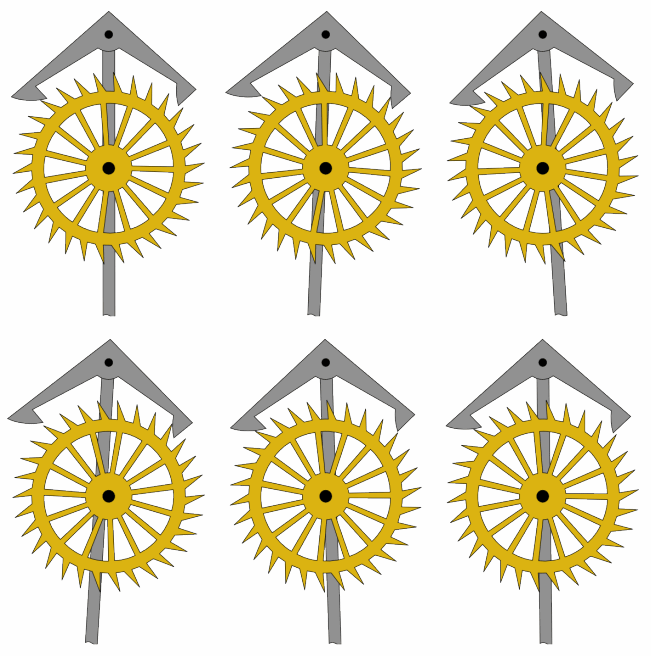
This is a model of a simple, mechanical pendulum clock.

1. The escapement wheel (yellow) strives to rotate clockwise (duh) drawn either by a spring or a weight hanging from a string wrapped around its axis.

2. The anchor (grey) allows the wheel to only rotate incrementally, one cog at the time, as directed by the swinging pendulum connected to the anchor. The force of the escapement wheel at the same time gives a little push to the anchor to keep the pendulum swinging. The clicking sound of a pendulum clock is due to the light tapping of the anchor arms on the escapement wheel.

3. The rest is a question of casing, gears and hands, translating the mechanism's movement to our definition of seconds, minutes and hours.

The very basis of clocks or indeed any time measurement device, is something observable that changes at a steady pace. This goes for the day to night shifting of our revolving earth, the flowing of sand in an hourglass, the behaviour of atoms in an atom watch or any other time measurement device. In a pendulum clock, the steady pace is set by the swinging of the pendulum, which is basically constant under given circumstances.

On the passage of time in Forbidden Lands

My reason for considering the mechanisms of clocks, is the following thought concerning the passage of time in the game Forbidden Lands:  

What if clocks exist that don't measure time,
but instead direct aging and passing of time?

 I haven't fully decided where to go with this, but I will know when the upcoming Alderland expansion is published. These are some of the question I'm pondering:

* What if the drive to age – the striving of the clock's escapement wheel to turn – is applied by intelligent beings, death gods or their minions constantly pulling at the feet of the living?

* What if the rate of aging – the swinging of the pendulum – is set by biological oscillation? We have several examples of molecules in our bodies that swing between two different states depending on circumstances, the taut / relaxed form of hemoglobin for instance. What if such a biochemical switch is purely cronological?

* What if the clocks of aging have actively been set by some intelligent being?

* If so, then why don't elves age?

* What if you came to a valley in Alderland where flowers periodically shifted from violet of orange due to the biological pendulum?

* What if some smart dwelvers have studied the biological pendulums? What if they found out how the mechanisms of aging could me manipulated, either by removing the driving force OR by jamming the biological pendulum.

* What if they already experimented with this several hundred of years ago, as they forged Horn's Astra and built the Metrochrone of The Sisters' watch in Aslene?

* What if the leading mind behind the current dwelver research has lost it and now appears in markets as a fool named The Pagnillo?

* What if the adventurers' task would be to find The Pagnillo to either kill it as a threat to world order OR to get it back on its research track?

Skulptör: Margareta Persson
Sculptress: Margareta Persson

fredag 9 april 2021

Reversed archeology


This month I'm participating in no less than four interviews concerning fantasy world building. Gathering my thoughts on the subject, it struck me that I practice archeology of sorts, only it's of a reversed kind.

Let me explain: In archeology proper, scientists make findings, classify them, compare to already sorted out patterns and try to deduce what the new findings imply. When I create fantasy worlds, I litter them with strange details that I often have only vague ideas about: rumours, historical persons, unexplicable artefacts and habits, etc. These details lie around in piles while I build. I contantly rummage around, twisting and turning what I happen to encounter, trying to understand how this particular piece fits in my stories and what on earth it's for. In my experience everything will always fit together in the end, in one way or the other, resulting in complex visions of something strange and fantastic. It's like putting puzzles together – I'm confident that every piece will fit, although everything appears to be a jumble right now. The confidence is key here, for without it you're tempted to give up. You can always leave a particular piece for later.

The reason for doing reversed archeology, as opposed to build in an orderly and planned way (which I also do), is that it keeps me curious and often surprises me. I don't work to explain something I already know everything about, but instead explore the unknown, getting the feeling that there actually is a strange world out there, waiting for me to discover. Hopefully I will pass my enthusiasm on to the players or readers. Strange connections constantly appear, things I wouldn't have thought of with pure intellectual effort. It doesn't matter that some details seem totally off, refusing to participate according to principles or even set natural laws – this is the way the explanations of our own world works, as the paradigm shifts of Thomas Kuhn. Another benefit, is that with the mere amount of strange stuff in my piles, some things will always fit with any new turn my tale takes, readily cascading into unexpected order, only to open up new possibilities.

You should try this! 

Of course, I at the same time work in more structured ways, but strictly rational creativity, or even worse: creativity primarily concerned with attracting money or followers, in my experience makes for contrived and even dead worlds that might entertain for the moment, but often leave a sense of unfullfillment behind. I find this a lot in current streaming services.


The picture shows the Antikythera mechanism, believed to be part of
a more than 2000 year old analog computer found in a shipwreck. Feel free to speculate about its use!

måndag 6 januari 2020

Herodotos idag


Jag har just läst klart Herodotos Historia, skriven åren runt 450 f.kr. Herodotes reste omkring i Medelhavet och skrev ner det som folk berättade för honom, utan att egentligen hävda att det han skrev var sant. Tvärtom så redovisar han ofta olika uppfattningar om samma sak, och berättar vilken av versionerna han själv håller för sannolik. Framställningen är lättläst och intressant och med några få undantag fri från uppenbara fantasier av den typ man ofta ser i mer sentida reseskildringar.

Hos Herodotos kan man bland annat läsa om hur spartanerna höll stånd mot perserna vid Termopyle. Mitt främsta skäl att läsa boken var dock att Herodotos ingående beskriver skyterna, ett ryttarfolk som höll till på de asiatiska stäpperna. Jag använder skyterna som förebild för aslenerna i den spelmodul jag nu ska påbörja för rollspelet Svärdets sång.

Mitt dominerande intryck av Herodotos historia är en värld som vadar i blod. Här betyder en enskild människa ingenting om han inte (det är nästan alltid en han) är härskare eller hjälte, helst bådadera. Krig är en manlig dygd och ett tillstånd att föredra framför fred. Det stilla livet som bonde eller hantverkare är föraktfullt. När Babylon står inför persisk belägring, får babylonierna (männen) välja var sin favorithustru varefter övriga hustrur stryps för att spara på maten – detta alltså innan belägringen ens har börjat. Perserna offrar i sin tur tusentals lojala, men ”sämre” soldater genom svek för att vinna taktiska fördelar. Etc.


Någonstans mellan Herodotos tid och vår egen, uppstod tanken att den enskilda människan besitter ett värde och inte bara har skyldigheter utan även rättigheter. Kristendomen och liberalismen bidrog utan tvivel till detta liksom många andra läror. Det beklämmande är att synen på den enskilda människans värde förefaller att erodera här och nu medan vi framlever vår dagliga och fortfarande ganska fridsamma tillvaro. Det fnyses föraktfullt varm luft ur tomma huvuden åt rätt, demokrati och fred, nu senast av president Trump, när han hotar med krigshandlingar som utgjort brott mot internationell folkrätt sedan 1899.

Till slutkapitlen av Herodotos läste jag också ett par akademiska artiklar skrivna av teologen och universitetsprofessorn Ryan LaMothe. LaMothe talar om övergångssubjekt – fantasivarelser som barn skapar och interagerar med för att lära sig förstå och interagera som självständiga personer bland andra självständiga personer. Tigern Hobbe i serien Kalle och Hobbe är ett exempel på ett övergångssubjekt. Till skillnad från psykologen Winnicotts övergångsobjekt, dvs snuttefiltar och liknande, så överges inte övergångssubjekten när vi blir vuxna, utan de blir en del av vår kulturella och sociala kontext. Genom dem lär vi oss att se oss själva och andra som fristående individer, en förutsättning för respekt, förståelse för avvikande åsikter, rättvisa och förmodligen demokrati i modern bemärkelse. Övergångssubjekten utgör därmed ett värn mot barbariet – psykoanalytikern Ludvig Igra skrev i sin bok ”Den tunna hinnan” att avhumanisering är en förutsättning för folkmord.

Trump hade förmodligen aldrig någon låtsaskompis.