måndag 1 december 2025

Arhem revisited


I have the pleasure of presenting you with David Brasgalla's very first illustration for The Brimstone Sleep (Sv. Svavelvinter) – the first part of The Conflux Cronichles that Free League Publishing currently is producing as an official adventure suite for the TTRPG Dragonbane (Sv. Drakar och Demoner 23). Myself, I'm reediting the texts as well as adding new content. Maps by Francesca Baerald.

The above scene pictures the adventurers' arrival to Arhem, the subarctic colony of The Tracorian Empire, where precious sulphur is being harvested in the marshes by convicted criminals.

The Brimstone Sleep was first published in 1987. Below you can see the corresponding original art by Stefan Kayat. I subsequently published a series of novels based on The Conflux Chronicles, and include some material from them in the adventures.

fredag 28 november 2025

The TV Couch


This is a november picture I took from my car as I waited for the ferry to Åland island. The TV people were already there, sitting in the dirty snow, I just added some cartoon details.

tisdag 4 november 2025

The Brimstone Sleep – revival 40 years later

The Brimstone SleepSvavelvinter in Swedish – was first published in 1987 as an adventure to the first version of Swedish table top role playing game Drakar och Demoner, aka Dragonbane. It was followed by three sequels and a booklet about Tracoria, the nation where it all takes place. These publications together are usually referred to as The Conflux Suite, and are still played. I later published a tetrology – four novels, in total 2300 pages, built on the Tracorian setting. As Free League Publishing started out, their first game was Svavelvinter, based on those novels. I also wrote the lyrics for a full album by metal band Svavelvinter, taking inspiration from the setting.

Now it's all started anew! Me, Tomas Härenstam and Svante Landgraf are currently working on republishing The Brimstone Sleep for Free League Publishing's version of Dragonbane. 
This post is a status update.

The Brimstone Sleep – Svavelvinter

I've already gone through all the texts, editing and rewriting while trying to keep the spirit of the original. For those unfamiliar with the setting, Tracoria mixes a renaissance, back stabbing setting with Mesopotamian polytheism, philosophical depth, war, horror, dark humour and a parody of our own times. The first part however takes place on the far northern island of Marjura, which the Tracorians have occupied in order to harvest precious sulphur. Svante and Tomas are now adapting the material for the Dragonbane rules and format.

The original publication contained a number of adventure sites which are all there, as well as a brand new one based on material from the novels. Since I this time know what will follow, I've made adjustments accordingly and indulged in some foreshadowing.

Concerning the maps, I've already proof-read two nice drafts of a Marjuran map by Francesca Baerald. We've also prepared material for main illustrator David Brasgalla and now look forward to seeing his first sketches. Johan Egerkrans will do the cover illustration.

 Beyond The Brimstone Sleep

 The next adventure in the conflux suite – original title The Four Eyes of the Oracle – takes the game back to Tracoria proper, where the adventurers try to rescue a number of important persons that simultaneously are hunted by the assassins of RhaboRana (which also hunts the adventurers). I already submitted suggestions on how that part might be adapted, and while nothing yet is decided, me and Free League are pretty much agreed on the structure. I will probably start editing and rewriting the material right away. In analogy with The Brimstone Sleep, I plan to add an extra adventure in the form of an extra person that needs to be saved.

We are in all probability looking at a Free League three part conflux suite, so the material of the Tracoria booklet and the original third part ”The Crystal Bull” will be worked into the remaining parts. For instance, I plan to put more focus on the island of Palamux already in this second part, where the adventurers have to cross the desert Focal Plains to reach one of the savees.

In this part, the players will be introduced to Tracoria, to The fifth conflux and the prophetic mountain of Ranz, having to interpret its prophecy Vox Ranzina.

It is likely that some of the original Tracorian material will appear in Helmgasts Dragonbane project Ereb Altor (the continent of which Tracoria originally was part and still is).  We will in that case try to sync the two project to let game masters seamlessly include those parts in Free League's conflux suite if they so wish.

Exciting times!

måndag 28 juli 2025

A Biography of sir Richard Francis Burton


I'm currently reading, and want to recommend the presented biography of Richard Burton. This is not the guy* who was married to Elisabeth Taylor, but the one who was a 19th century polyglott, spy, soldier, poet etc; the man who translated The Kama Sutra and Arabian Nights into English; who in disguise as a moslem dervish travelled to the holy city of Mecca; who took part in the search for the source of the Nile and a person who in many aspects was larger than life. He is also the protagonist in Philip José Farmer's SciFi epic Riverworld.

It is a fascinating read about a time and a world so different, and yet so crucial to understanding our current times. The author, Edward Rice, in addition to vividly picturing the immensely strong-willed explorer (in this aspect reminding me of Nietzsche), also makes the Middle East from almost two hundred years ago come alive in inspiring detail.

For instance, I read about the Portugese concept of Saudade, which fascinated Burton. Saudade allegedly is an untranslatable word described as feeling the "presence of absence – not merely something that isn't there, but an absence felt acutely with longing, almost as a tangible entity.

Or the Arabian concept of Kayf – a state of blissful animalistic contentment, a state of being, not doing. Picture a cat, basking in the sun. Unlike Western concepts of happiness, tied to activity or accomplishment, "kayf" is about savoring the present moment without striving for anything.

 
In my mind I'm playing around with The Drawn Lands – an upcoming desert type expansion to the Forbidden Lands TTRPG game world, and for inspiration, this book is solid gold.


* Incidently, I based Gottard of Melse, the bailiff of Marjura in ”The Brimstone Sleep” adventure which I'm currently reediting for the Dragonbane TTRPG, on the actor Richard Burton, so I like him too :-)


(RPG = tabletop role-playing game, if you didn't know)

The book was published by Charles Scribner's sons in 1990 

måndag 21 oktober 2024

Descendants of a Mad King


While doing research for a novel project, I checked up on my lineage to Swedish king Gustav Vasa. Gustav's son Erik, who is also my ancestor, became king after his father as Erik XIV, but it didn't end well for him. Since I'm also Erik XIV, being the fourteenth generation from Gustav Vasa, I try to restore my distant relative by picturing him in the novel. Alas, I have a feeling it won't end well this time either…

Here's my complete heritage line
(researched by my father Birger)


Gustav Vasa, f 1496
Erik XIV, f 1533
Virginia Eriksdotter, f 1559
Elisabet Hand, f ?
Johan Gyllensvärd, f 1617
Gustaf Adolf Gyllensvärd, f 1652
Märta Eleonora Gyllensvärd, f 1701
Carl Magnus Krusell dy, f 1730
Carl Johan Krusell, f 1758
Carolina Charlotta Krusell, f 1802
Joseph Napoleon Lindhé, f 1827
Sven Lindhé, f 1865
Karin Nordström, f 1899 (my grandmother)
Barbro Granström, f 1926 (my mother)
Erik Granström, f 1956

Gustaf Fröding wrote some poems where king Erik XIV laments his fate. These poems were set to music by Ture Rangström, and I especially play this one as inspiration. In it, the king, somewhat desperately, celebrates the capture of members of the Sture family with his prison master and hangman Welam Welamsson. Soon king Erik will have the Sture nobles killed, loosing his mind and running off into the woods in the process.


Illustration by Daniel Falck, picturing the legate Ludenbrand for the game Svavelvinter by Free League Publishing. Erik XIV was a model for the Ludenbrand illustration along with Steve Jobs and a friend of mine.


måndag 25 december 2023

On the Working of Clocks

undefined 

This is a model of a simple, mechanical pendulum clock.

1. The escapement wheel (yellow) strives to rotate clockwise (duh) drawn either by a spring or a weight hanging from a string wrapped around its axis.

2. The anchor (grey) allows the wheel to only rotate incrementally, one cog at the time, as directed by the swinging pendulum connected to the anchor. The force of the escapement wheel at the same time gives a little push to the anchor to keep the pendulum swinging. The clicking sound of a pendulum clock is due to the light tapping of the anchor arms on the escapement wheel.

3. The rest is a question of casing, gears and hands, translating the mechanism's movement to our definition of seconds, minutes and hours.

The very basis of clocks or indeed any time measurement device, is something observable that changes at a steady pace. This goes for the day to night shifting of our revolving earth, the flowing of sand in an hourglass, the behaviour of atoms in an atom watch or any other time measurement device. In a pendulum clock, the steady pace is set by the swinging of the pendulum, which is basically constant under given circumstances.

On the passage of time in Forbidden Lands

My reason for considering the mechanisms of clocks, is the following thought concerning the passage of time in the game Forbidden Lands:  

What if clocks exist that don't measure time,
but instead direct aging and passing of time?

 I haven't fully decided where to go with this, but I will know when the upcoming Alderland expansion is published. These are some of the question I'm pondering:

* What if the drive to age – the striving of the clock's escapement wheel to turn – is applied by intelligent beings, death gods or their minions constantly pulling at the feet of the living?

* What if the rate of aging – the swinging of the pendulum – is set by biological oscillation? We have several examples of molecules in our bodies that swing between two different states depending on circumstances, the taut / relaxed form of hemoglobin for instance. What if such a biochemical switch is purely cronological?

* What if the clocks of aging have actively been set by some intelligent being?

* If so, then why don't elves age?

* What if you came to a valley in Alderland where flowers periodically shifted from violet of orange due to the biological pendulum?

* What if some smart dwelvers have studied the biological pendulums? What if they found out how the mechanisms of aging could me manipulated, either by removing the driving force OR by jamming the biological pendulum.

* What if they already experimented with this several hundred of years ago, as they forged Horn's Astra and built the Metrochrone of The Sisters' watch in Aslene?

* What if the leading mind behind the current dwelver research has lost it and now appears in markets as a fool named The Pagnillo?

* What if the adventurers' task would be to find The Pagnillo to either kill it as a threat to world order OR to get it back on its research track?

Skulptör: Margareta Persson
Sculptress: Margareta Persson

onsdag 18 oktober 2023

Me and our Community


In this triptych you see three versions of the map of Ravenland, which is the initial gaming area of the role playing game Forbidden Lands from Free League Publishing.

* To the left is my very first draft of the map, made with pencils on paper.
* In the middle you see the finalized black and white version that you'll find on the inside covers of the gaming books (there is also a separate, coloured version in poster format)
* To the right and below is a brand new wooden version made jointly by Samuel Nedergård Bergsten and Ronja Eriksson as a gift for a gaming friend. They have divided the map in three layers (mountains and forest, plains, water). These layers were then laser cut, engraved and lastly glued together yielding this piece of art.

Seeing their work really warmed my heart. It also gave me an opportunity to thank all fellow enthusiasts – gamers and creators alike – for all the collaboration and obscure discussions and projects we've had the pleasure of sharing during the years. Considering all the hate and lies and manipulation that goes on in the world today, I find that me and our community in some respect share what is actually the best features of humankind: passion, project cooperation, creativity, unselfish helpfulness and love! Some may call rpg gaming simply entertainment and escapism, and for sure there's room for that as well, but what counts for me is the practice of humanity and the warmth I encounter in doing so. I'm convinced that this type of shared enthusiasm makes the real world better. Thanks, my friends – let's keep doing this!


lördag 8 juli 2023

Sex in The Bloodmarch


SPOILER WARNING – for The Bloodmarch, a Forbidden Lands RPG expansion below. Also be warned of SEXUAL CONTENT (though not explicit really).

.

My original text to The Bloodmarch had some sexual content in it, most of which was edited out by Free League. They explained that they have to be careful due to various international laws and standards and also due to some recent RPG-related scandals that you might have heard about. I can understand and accept that. Still, I'd like to share some hints on what was there in the first draft, not only because I like raunchy details (which I do), but also because some of it has connections to the plot that you might want to explore. GMs can include these sexual elements or leave them out according to group preferences.

Disclaimer: Free League Publishing is not responsible for what I'm writing in this blog post (or any other). These are my personal musings.

.
.
.
.
.
.
.
.
.
.
.
.
.
.

Sex at Ashenstead
1. In the adventure site Ashenstead there's an upcoming wedding between the son and daughter of two Aslene clan leaders. One event had Merdekai, the father of the bridegroom, claiming ius primae noctis according to ancient customs – that is the right to sleep with the bride on her wedding night. The bride and her father were naturally outraged. It is uncertain whether Merdekai meant what he's saying OR whether it was a test of his counterparts / his son's balls OR a way to start a civil war (which Grudenstaal doesn't want if he's there). In any case, the adventurers are asked to solve the situation diplomatically. One solution is to access the temple's library and verify that the custom of ius prima noctis is stated only in some apocryphal texts that may be refuted.

2. The high priests Liklaudos and Melgir are to have public, ritual sex on the temple roof as part of the wedding ritual, which makes Melgir's husband Tordenost madly jealous. Murders take place, the tower Kardena's watch is made to fall into the abyss with the lovers in it, and the adventurers have to investigate whodunnit. An alternative perpetrator is the penitent dwarf in the temple hall that knows magma song.

Sex at The Watch of the Sisters

The mad composer Cavaldo is based on the actual, historical 16th century composer and prince Carlo gesualdo. In historic reality as well as in the first draft of the adventure, Cavaldo caught his wife and her lover making out in flagranti and brutally killed them, a deed that distressed him for the rest of his life and affected his work. In the game, the forest spirit Margarita fuelled his wrath towards the lovers in order to increase his musical passion.

Sex at Oxengelder
The garden of Novices in the original text was kind of a hippie park with free sex, dream and drug experimentation aiming to free your body and mind for true oneiromancy. Two charismatic young dreamers were leading these orgies, that in one event got out of hand, tranforming the participants to agressive beasts. There was also an aphrodisiac called Libertine involved, that could lead to interesting complications. The male leader of this crowd called himself ”Olof Skötkonung”, which I though was somewhat funny (actual name of historical, Swedish king, but untranslatable joke I'm afraid ;-) ). The female leader was namned Vilega Starsight as a homage to the raunchy online comic ”The Cummoner”. The elders of Oxengelder frowned upon these practices, but couldn't do much since the Dreamstress herself didn't seem to care.

Fiena Fromelei having sex
In the original text the escort goblin Crudehack, protected Fiena Fromelei so closely that he made her pregnant without she neither understanding what was going on or that she is carrying a child. Fiena's daughter could become a moonelf after birth as an alternative to herself.

Some additional sexual couples in the original text
Kurmena and Eisendor in Taregyll
Vaerfor van Reiben and the Dreamstress
Draug of the White and Mildella (reluctantly from the latter, as part of her debt)
Poansa and Grudenstaal if they join forces

tisdag 4 juli 2023

En målning byter ägare


En av mina vänner, den spännande konstnären Mark Frygell, har köpt Steven Stahlbergs (tidigare Steven Hägg) originalmålning till det ursprungliga äventyret Svavelvinter från Fredrik Malmberg. Mark bytte den mot en av sina egna målningar och båda verkar lika nöjda över transaktionen.

Mark och jag har ofta intressanta och öppna diskussioner om rollspel, konsten, livet och kreativiteten. Han är helt rätt person att förvalta målningen, eftersom han som gammal rollspelare vet hur viktig den har varit för många genom åren, och dessutom kan visa den där den bör visas i konstkretsar. Fredrik uttryckte för sin del önskemål om att målningen ska tillgängliggöras för de intresserade och inte bara hängas undan privat, vilket jag vet inte heller är Marks avsikt.

När jag pratade med Mark vid midnatt igår så hade jag ändå blandade känslor eftersom jag själv hyst funderingar över att försöka köpa målningen. Treåringen i mig ligger fortfarande och surar på golvet, men samtidigt är jag övertygad om att detta var det rätta och att verket hamnat i bästa händer! Världen blev rentav lite mer spännande.

Kanske får jag till och med snart se tavlan i verkligheten såhär trettiosju år senare ;-).

söndag 16 april 2023

The Unreliable Narrator

File:Gustave Doré - Baron von Münchhausen - 034.jpg


There has been a discussion on Discord recently about the pros and cons of the Unreliable Narrator style of the Forbidden Lands Roleplaying Game (RPG). Being one of the lead writers of the game and of its concepts, I thought I'd give my personal view and explain where it comes from. Now, I'm not that familiar with most RPGs, so I assume there are unreliable narrators in other games as well, but if so, my inspiration might come from elsewhere, and the setup might differ. I wouldn't know.

According to Wikipedia, an Unreliable Narrator is a narrator whose credibility is compromised. This can be due to a number of reasons: bragging, lying, filling in the gaps, misunderstanding, hallucinating etc. Unreliable narrators are not uncommon in first person renderings nor in movies, where at best the unreliability results in a twist – called Peripeteia by Aristotle.

In computer games, simplistic twists are common, often meaning that the good guys that you worked for actually turn out to be bad and vice versa. In an RPG however, the narrator traditionally is reliable: The Game Master (GM) reads how the world really works in the rule books and sets the game up accordingly. There is an actual, objective answer to most questions, for instance whether gods exists, how beings came into existance and how magic actually works. The players, on the other hand, often get fed lies and incomplete speculations, the decoding of which make up a big part of the game. 

Not so in Forbidden Lands. In the basic Game Masters Guide, the GM may indeed read the elaborate history of the land, get descriptions on the kins (aka ”races”, which is a term I avoid out of various reasons) and their origins, read about gods etc. Pretty soon, however, the GM gets the impression the none of this seems to be entirely true. Do the gods actually exist? Is the presented history merely human-centric and politically biased – one narrative out of many possible ones? Did the dwarves actually build the planet? did the six primordial elves actually organize life? Were orchs made as a slave kin? Were humans led across the ocean by a raven god? Etc. The GM can't be sure.

I'm not aiming for ”gotchas” with this insecurity – setting up false pretenses and dropping red herrings to fool everybody. Nor do I seek to raise elaborate illusions that suddenly vanish into thin air. 

My aim is instead to present facts, legends and observations about the forbidden lands that the viewer may percieve as patterns – different and ever changing patterns depending on changing perpective and new information coming up. Some of this stuff I won't even know about, since it is created in your individual game, but I'm confident that you'll make sense of it, since humans basically are pattern-oriented beings. Ideally, earlier observations may be fitted into the amended narrative, but in a new way, rather than turning out to be plain false, which of course also will happen as players know from the game's legends.

What I don't do in the Forbidden Lands RPG is present a ready-made pattern – ”the truth” about he world that many ask me about. Instead, I basically describe the forbidden lands in line with how I perceive our own world. Things happen around us all the time, and we try to make sense of it, fitting new information into contexts we already believe, arriving at the currently most useful and probable patterns, amending them as we go. This is also how research works.

I'm not saying I'm an adherent to alternate or totally made up facts like some current politicians and dictators. Things are and things happen. People say, see, think and do things that can't be denied, also in a game world. It's when we interpret, descibe and put these things into narratives and patterns that it gets weird. I do not believe that there even IS an objective way to decribe something at all. As soon as something is put into words, we have done assumptions concerning what and how something is to be told and in the process inevitably have discarded innumberable alternate ways to say it. This doesn't mean that anything goes, or that all descriptons are equally true – just like in research, different narratives fit more or less well with actual observations and also may serve different purposes.

The approach might be called postmodern, and was for instance used by writer Umberto Eco in ”Foucault's Pendulum” and ”The Name of the Rose”, where the protagonist, the detective monk William of Baskerville, strings together facts to a pattern that makes sense but turns out to be wrong.

So why don't I give the truth concerning The Forbidden Lands? Well, I personally think it gets more interesting and flexible and opens for more vividness and depth with some uncertainty. You may also see the unreliability as a challenge to myself as creator and to you as GM's and players, challenges delivered with love and confidence in your ability. Some may like it – some don't, but then there are other games.


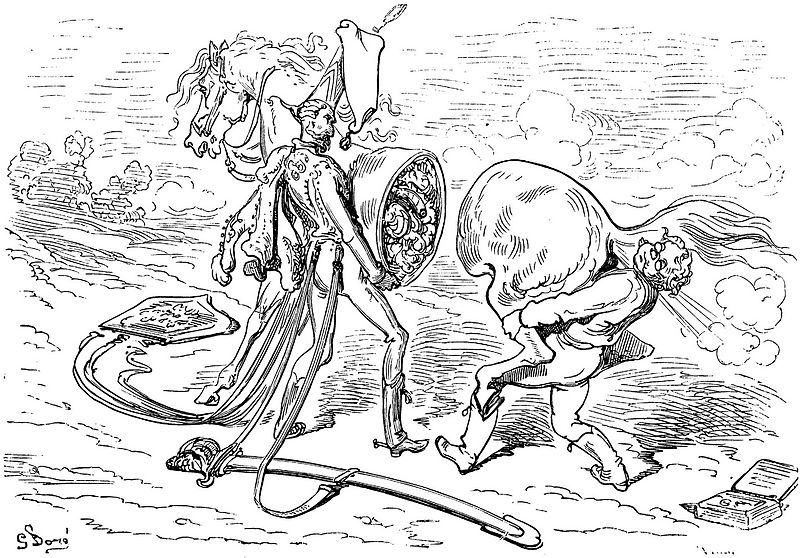
The picture shows baron Münchhausen putting together his horse that was acidentally severed in two.
Artist: Gustave Doré


tisdag 7 mars 2023

The Maha Language


Maha is not about you. 

It is not about the world. 

It is about melding your mind to the world.

    /Gremerdin the speaker


The pictogram Maha Language of the Elvenspring druids is described in the Forbidden Lands RPG. Players may encounter it as a puzzle in the adventure site Pelagia of the campaign Raven's Purge. What is presented there is pretty limited due to practical reasons. In my first drafts of the game I had the ambition to use the Maha language as a foundation for druid magic and to invite players and game masters to add to the language to see were we would end up. Since some interest was aired in the game forums, I here present my initial thoughts on the language and its structure. Note that this is an unpublished draft and not official in any sense, but please lets discuss what you think!

Picture by Niklas Brandt. These are just examples of signs, not the complete Thesaurus.


Maha Language and Druid Magic

According to myth, Maha is the creation language of the god Clay. It is used by elves and elvenspring druids. The signs are often written on small clay tablets, that are burnt and combined when used. The tablets regularly have a hole drilled in the upper right corner, showing their orientation. Druids often carry their tablets on a string through the holes.


The Basics

* Maha is a holy, incomplete pictogram language. It is traditionally used to create statements that describe and affect aspects of the world, magically enforcing the statements or making them come true.

* Maha is a written language of symbols. There is no specific spoken language connected to it.

* Maha is normally not taught. Learners are supposed to gain insight by personal interpretation of statements.

* Maha signs are pictograms. Statements are formed by arranging secondary signs around primary signs.

* A mirrored sign means its opposite. For instance signs for ”white” and ”black” mirror each other. Symmetrical signs have no opposites.

* Maha signs are seldom complex or abstract and never decorated. Brevity, simplicity and clarity traditionally means more power and are the signs of a master.

* Individuals and places might be given unique signs, unless their names have a meaning that may be written as a statement.

* A laid down Maha statement may normally be interpreted in several ways over time. ”The most convincing sign” is usually accepted as true, being the interpretation chosen by the majority of respected interpreters. An already placed Maha statement may change meaning as new, more convincing interpretations come about. It is believed that this also changes the effect of the statement on the world.

Structure of Maha statements

 The primary sign (1) is mandatory. It is traditionally marked with a drop of the writer's own blood as a tribute to Clay. Druids often carry a small lancet for this purpose. Less convincing, the primary sign might be marked by having its edges blackened.

Secondary signs (2-5) are added as needed. Their position in relation to the primary sign determins their meaning. There may be more than one secondary sign in each position. Additional ones are added further from the primary signs, and certain schools make a point of the distance to the primary sign. A shorter statement is however always preferred. Statements may be added in sequence after each other to make longer sentences. The more traditional way is however to arrange statements in groups, leaving more room for interpretation.

General key:
1 = Noun
2 = verb
3 = adjective / adverb
4 = grammatical form (like plural or genetiv or imperative mode)
5 = numbers and operators (and / or / if – then / not etc)

The same sign changes meaning when it is placed in different positions. For instance these are all the same Maha sign:


Fire (1)
Burning (2)
Hot (3)
Imperative form (4)
Melded with (5)

Everyday use of Maha signs

Maha signs are often used to reveal information or wisdom in druidical holy places. Oracles might for instance offer a Maha statement. It is up to the reader to understand, and if the reader doesn't do so, he is considered not to be ready for the statement. Druids often use Maha signs for meditation and prayer, alone or in group placing Maha statements, contemplating on the shifting meanings and investigating interpretative changes when secondary signs are shifted.

Magical use of Maha signs

(I took some out here – if we were to use Maha in magic we would need to gamify)

Druids may use the Maha language for magic. Depending on skill, the druid may carry a limited number of signs for this purpose. The limitation doesn't depend on weight or space of the signs, but instead on the mental capacity of the user – how many he ”knows” and is able to focus on, i.e. connected to skill. The carried signs may over time be exchanged for others, but this normally takes a few days.

The basic function of Maha magic is that what is stated becomes true in reality, subject to the skill level of the druid. The effect is also subject to the interpretation by the majority of readers around (in practice, the druid player may place a statement and the other players get to interpret. Majority decides effect).

Maha signs used for magic should be made by the user. Statements are activated by placing a drop of the druid's blood on the primary sign.

torsdag 26 januari 2023

Mannen med hammaren


En man går runt med en spik
Man frågar: vad är det han vill
Då svarar han blygt sin publik
Jag vill bara att ni står still
I morse han rusade ut från sin kammare
irrade runt med sin spik och sin hammare
klöser med spikens hungriga klo
Jag söker en mening, jag söker min ro
Hans hela karaktäristik
är att vara en man med en spik.

Hans hammare hörs genom byn
om än tonen i slagen är stum
Han höjer sin spik emot skyn
för att söka en tid och ett rum
Han prövar vart plank, verkar noga och händig
Jag söker en vägg som är frisk och beständig
letar ett fäste att hålla en bro
Jag vill vara säker, jag vill inte tro
Han är en förunderlig syn
denne man och hans spik uti byn.

I trä vill jag fästa mitt hopp,
och när spiken till slut sitter fast,
ska världen ha stadigt förlopp,
så tänker han denne fantast.
På spiken jag hänger vår hägrande framtid,
värmen jag saknar i kyla och samtid
hänger en blomma, jag hänger en frukt
allt annat som spirar ur drömmarnas fukt
Jag famnar min älskades kropp
på bädden av levande hopp.

En man går runt med en dröm
han drömmer att något ska gro
Hans hand är stadig och öm
Han hoppas få bygga en bro
Man frågar sig: hittar han nånsin sin bräda
Ska han och vi andra den bron få beträda
Nån uppgivet skrattar: Vad är det han vill
Kanhända han lyssnar, men stannar ej still
Han söker sig inte beröm
Han går bara runt med en dröm.


torsdag 10 november 2022

Fantasy world creation as a research project

https://blogger.googleusercontent.com/img/b/R29vZ2xl/AVvXsEiHgNViLDh1ZWVine2rTymOj_O6IRqt9PjEwzOmqcGRG5ltaN0rPxtEb_cGNFP13kSHoys5WKo_4EoBqIOY6v3DOF8WtBGruqZrxa58Il_c_heV5PXgX8sV4XBM7E1Q3t0YZY3lT03WwWs/s1600/Universum.jpg


I'm not a researcher, but I've worked as CIO of two universities and as an editor popularizing research, so I am reasonably familiar with the nature of research. While following an esoteric discussion on the reproduction of two fantasy species in the game Forbidden Lands, some similarities between research and fantasy world creation suddenly struck me. I'd like to tell you about it, since it explains the way I work – not telling more facts than the basic necessities about my fantasy worlds, which some find frustrating. Questions might concern how magic actually works, whether the gods actually exist or not etc, i.e. – truths and facts.

Similarities with research
An experimental research project might come from an idea that you want to test, but often it is initiated because you scent a pattern in an already existing material, perhaps a structured deviation from expected results, or just the feeling that something is to found that hasn't so far been adressed. In the latter cases, you start with a heap of existing data and try to see patterns that might be further tested and purified and brought to conclusion.

This is exactly how I build my fantasy worlds. I start with some general, pretty simple vision and then start piling up unrelated ideas and dig for inspiration wherever I can find it. When I reach a certain volume of statements and ideas about the world, patterns always emerge and new connections show up, often in ways I couldn't know before discovering them. It's a process you need to have faith in for it to work. People often ask me whether I knew my complex world and story from start, but I never do and I wouldn't want to. Things I can plan in advance might run like clockwork, but they are never as alive as things I myself discover along the way, often with the happy elation of an explorer rather than as a methodical creator.

Differences from research
The main and obvious difference from research is that fantasy worlds are created from made up facts and ideas, but once you state these ideas, they ARE the fixed reality of the fantasy world and from there on they might be treated as actual facts and be mulled over and researched upon, making new patterns emerge. This however also shows the danger of establishing facts about the fantasy world, since once something has been stated and published, it's a FACT and cannot be taken back without loss and/or pain. Thus I never say more than I have to, since it keeps my options open, and makes way for new twists and discoveries. You will see this in the currently released expansion ”The Bloodmarches”, where old mythological beliefs suddenly are turned upside down. I think this makes fantasy worlds more alive and gives them depth. There's a trick to avoid facts that I used a lot in my Trachorian setting. As the world creator I seldom said ”this is how it is”. Instead I said ”this is what is claimed in the imperial academy of Tricilve”. After all, they might be right or they might be wrong at the academy.

Conclusion
So in the esoteric discussion on the reproduction of fantasy species where I started, questions are asked, but rather than answering them right away (which I no doubt could do if I put my mind to it, nailing the discussion shut), I follow, tease, comment and investigate the many suggested solutions from others. These in turn give me new ideas, making patterns appear due to the mere volume of ideas presented. We thus create together in a metagaming spirit! It's a wonderful fantasy world!

tisdag 30 augusti 2022

Liberalism in Dark Fantasy Ages

I'm currently reading ”Liberalism in Dark Times” by Georgetown univerity scholar Joshua Cherniss. The book describes how a number of liberally inclined, twentieth century thinkers, including Albert Camus and Isaiah Berlin, tried to deal with anti-liberalism and totalitarism, mainly nazism and Soviet communism.

The main concern in the book is how to adress ruthlessness and cruelty without becoming so ruthless yourself that you loose your liberal essence and soul. That is: how do I fight, stop and if necessary kill bad guys while not staining my own hands, becoming as bad as they are. Liberalism should after all be based on law, individual rights, tolerance, acceptance of diversity and freedom of speech. These questions are very urgent also today, as democratic societies wrestle with an openly aggressive and repressive Russia as well as with internal, populistic lies and organized crime.

There are however no simple solutions, as there seldom are in non-totalitarian politics. Cherniss leans towards liberalism founded in ethos, that is a personal conviction of liberal norms, rather than having liberalism rest on ideology. The problem with the latter is that it often slips into expedience; ”the end justifying the means”. You've been brutalized, so you're justified to be brutal in turn. In Star Wars, you would turn to ”the dark side of the force”. Instead Cherniss wants you to retain your soul and resist the temptation to quick and dirty fixes. This is not simple, but perhaps the only way. I wrote a blog post (in Swedish) on a simliar subject: that extreme positions tend to get stuck and inflexible, while interesting development only takes place in the instable balance point between them. I compared this position to the equivalence point in chemical titration, where small changes yield major effects.

Liberalism in my fantasy writing

I'm currently working on two expansions to Free League's role-playing game Forbidden lands as well as writing a fantasy novel in the game setting that I had the pleaure of constructing. Cherniss' book has given me unexpected and useful input. In the game you meet ”The Rust Church”, a fascist religious organization. What I learned from the book is that many (not all) early Soviet communists and German nazis started out in good faith; that they solidly believed themselves working for a good cause. Being part of nonliberal movements, they however were told that their personal opinions and comforts would have to be sacrificed for the greater, common good. Indeed, the weak of stomach had to prove their loyalty by demonstrating cruelty and abscence of empathy – ”Squeamishness is the Crime” as is the title of the first chapter. Once this threshold had been overstepped, people could stand working in prison camps. I like giving my bad guys some kind of rationality rather than just being sadistic and ”bad”, so I'll probably use similar mechanisms for the Rust church. Add some historicism – the belief that your cause inevitably will prevail, and that anything implying the contrary is fake and heresy – and you're set for disaster. As Bolshevism had it: good can issue from evil.

For liberal champion, I will use the elf Mergolene from the game, advocating moderation, respect, coexistence and reasoning to fellow elves that feel justified in raiding and killing the orchs at The Eye of the Rose, a fortress once built by elves. Mergolene will probably be the protagonist of the second novel in my series. The more aggressive elves will advocate the temptations theatening fed-up liberals.

By reading and using books on history and political theory, I get the opportunity to discuss and adress current problems in our own world while writing about fantasy stuff in made-up lands.

Simply the best of two worlds!

måndag 13 juni 2022

Gudarna är döda!


Efter sju års spelande publicerade podden Vi Spelar Rollspel idag det sista avsnittet av konfluxsviten. Den femte konfluxen inträffade och kaklunen – en lika skrämmande som lysten kärleksvarelse – kom att dominera ödespunkten, frammanad för ändamålet av äventyrarna. Kaklunen hade lovat dem en värld utan gudar och sådan kommer världen att bli. Alla var inte med på noterna och manfallet blev också stort under finalen.

Om en vecka ska spelledaren Axel Widén och hans spelare tillsammans med mig spela in ett eftersnack. Sedan börjar jag och Axel att fundera över hur en fortsättning bortom konfluxen kan gestalta sig i ett helt ommöblerat Trakorien.

Spelare och spelledare i Vi spelar Rollspel har imponerat med sin kreativitet, konsekvens och sina rolltolkningar under alla dessa år. Jag är stolt över att ha fått leverera dansgolvet på vilket de dansat.

”Gud är död! Gud förblir död. Och vi har dödat honom. Hur ska vi trösta oss, vi alla mördares mördare. Det heligaste och mäktigaste världen hittills ägt har blött ihjäl under våra knivar: vem ska torka av oss blodet? Vilket vatten finns för att rena oss?”

Friedrich Nietzsche, Den glada vetenskapen


lördag 5 februari 2022

Marozias resa


Romanskrivandet löper på ganska bra för tillfället. Huvudpersonen Marozia har, jagad av rostkyrkan, hittat till Vädersten, borgruinen där den döde kung Algarod och resterna av hans här osaliga vandrar omkring sedan tiden före Blodsdimman. Broväktaren har på Merigalls förslag sökt upp den fredlöse, alderländske soldaten Rintra Avhändaren som fått uppdraget att bära bud till den döde kungen. Därmed ska Rintra visa sig värdig en plats hos rebelledaren Zertorme.

Jag har åtminstone kul!

måndag 31 januari 2022

Järnlåset


Mondefort av Terova

I natten faller regn över Järnlåset. Det regnar så kraftigt att en främmande betraktare kunde ängslas över hur låsets järn ska rosta ihop för all framtid och aldrig mer kunna öppnas. Sådana omtankar är emellertid bortkastade eftersom Järnlåset är en mur som saknar både lås och port. Muren är rest mot en bergvägg och vid dess fot börjar Ravland som en benbeströdd sluttning inne i en ravin. En människokropp som kastas utför muren hinner uppleva ytterligare sex hjärtslag innan både kropp och hjärta krossas mot stenarna nedanför. Andra tilldöms mildare förvisning från Alderland, och det enda som möjligtvis kunde rosta på Järnlåsets mur är den kran med vinsch som sänker ned dem. Oaktat straffets mildhet åläggs alla fredlösa en livslång fördrivelse. Kranen och vinschen hålls väloljade. De kommer därför inte att rosta ens i regn.

Den här natten klamrar en liten flicka vid sin fars ben på murkrönet. Hon skakar av gråt, av köld och av skräck, men hans hand stryker henne lugnt över håret.
”Marozia, har du betänkt en sak? Vi kommer att se sådant i Ravland som inte ens kungen i Brodelmarg känner till!”
Fingret pekar ut mot mörkret där det egentligen inte finns något att peka på. Vatten dryper från rockärmen liksom från mannens skägg.
”Var är mamma?” piper barnet.
Hans hand på hennes hjässa stannar för ett ögonblick, fingrarna kröks lätt som ville de bli klor ägnade att söka grepp i tillvaron, och flickan blir rädd att hon än en gång har sagt fel saker. Snart stryker faderns fingrar igen.
”Mamma kan inte följa med. Hon måste stanna med Berden och katterna, men hon lovade att komma till avsked.”

När flickan vill fråga mer, drar fadern henne intill sig, för att värma och trösta och kanske för att tysta henne. Tillsammans stirrar de från murkrönet ut i Ravlands natt. Han har tidigare stått på samma plats när han övervarat andras förvisning, det var medan han fortfarande hade en upphöjd ställning vid hovet. Även under ljusan dag och utan regn skulle inget annat än en benbeströdd bergsklyfta finnas att se långt därnere. Det vet han.

En officer från De tysta söker parets uppmärksamhet, men säger förstås inget eftersom tystnadslöftet är strängt och livslångt. Mannen håller fram ett timglas i ena handen och en pil i den andra, vilket betyder att de förvisade har samma tid på sig att lämna Järnlåsets närhet sedan de sänkts ner i Ravland, som det tar för sanden att rinna genom timglaset. När sanden förrunnit skjuter vakterna såvida de fördrivna fortfarande är inom skotthåll. Fadern har sett flera förvisade medvetet stanna och låta sig genomborras till döds hellre än att söka sig ut i det fredlösa Ravland, men det ödet är inget han planerar för sig och för dottern.

”Sänk ned oss redan nu under natten!” säger han.

Den tyste låter handen med timglaset beskriva en båge över sig och visar därmed att de dömda har rätten att vänta på soluppgången, men fadern insisterar. Officeren irriteras, eftersom männen därmed berövas den spänning i tristessen som det innebär att söka pricka flyktingarna med sina pilar. Många andra nöjen gives inte vid gränsen, men han kan inget göra – den fredlöse har varit en betydande person i Alderland och har förmodligen kontakter man vill hålla sig väl med. Fadern vet för sin del att han och dottern får mer tid på sig att att lämna Järnlåset om det är mörkt runt dem. Barnet är redan utmattat och kan därför inte springa eftersom de har varit på resa mot norr under två dygn i en obekväm fångvagn. Skulle rovjur vänta på dem därnere i klyftan så löper de istället ökad risk att skadas, men fadern, vilken under en tid tjänstgjorde som heraldisk minister, är van vid att bedöma givna alternativ och har alltid satt en heder i att fatta omedelbara beslut. Officeren nickar bistert innan han går till sina förberedelser.

fredag 31 december 2021

Sex, Soul and The order of Egression


I've recently read two books, that to my surprise and delight held unexpected similarities although they at a first glance seemed to be very unrelated:

The Soul of Sex, by Thomas Moore (1998)

and 

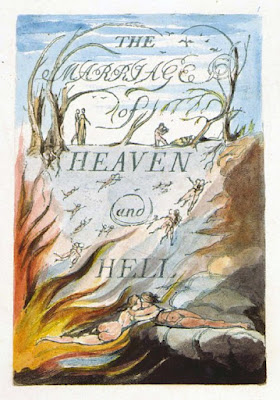
The Marriage between Heaven and Hell, by William Blake (1793)

Moore is a psychotherapist, theologian and former monk, who with his book aims to do away with the concept of soul and body being different things, one good – one bad, one elevated – the other base, etc. He suggests that we can only live a full human life if we care for both, respecting bodily pleasures while placing these in a wider context. It's a very rewarding book to read, and I especially liked Moore's historical examples (among these, I find the etymology of the word ”fascination” hilarious: it stems from ”fascinum” – penis-shaped talismans carried by the Romans.)

Sensation can not be separated from imagination. We are always living in a story, always surrounded by images, and always percieving with imagination.

Blake's book basically says the same thing, illustrated in Blake's unique style, wanting to do away with the separation of soul and body, referred to as ”reason” and ”energy”, the former represented by anemic angels and the latter by passionately roaring devils. That is, he wants the two to marry:

Man has no Body distinct from his soul; for that called Body is a portion of a Soul discerned by the five senses, the chief inlets of Soul in this age.


In Ravenland

Apart from taking a personal interest in both books, I find them useful for the Ravenland novel I'm currently writing. My protagonist is a doula of The order of Egression, a bunch of people helping the restless dead to actually die in the name of the mysterious Nightwatcher God*. Books like the two mentioned help me flesh out the egressors' beliefs and hopefully make them more plausible. The Nightwatcher is a god of transition, of passages from one stage to the next – and not only life to death. He watches over opposites and the merging of these, since they are actually considered one. As Blake puts it:

Without contraries is no progression. Attraction and repulsion, Reason and Energy, Love and Hate, are necessary to human existance.

Enantiodromia was Carl Jungs name for when one extreme flips into what seems to be its opposite, but which is actually its yin-yang-ish complement. This I learned from Moores book.

To me, Nietzsche's attraction to passion and acceptance of both body and soul – good and bad experiences, hoovers over these waters. Now, I don't agree with everything that Nietzsche says, nor with Blake, Jung or Moore, but they are all inspiring – on a personal level and especially for writing fantasy novels.

* The Nightwatcher's name in Swedish would correctly translate into ”Being the Night”, which I find far cooler.


onsdag 15 december 2021

On gender equality in Trachoria

Sandra Zurbuchen & Corina Wehinger

Sweden recently won the World championships in floorball* for both women and men. Both Swedish national teams beat their Finnish counterparts in final matches that were even and could have ended either way.

For the first time ever, two women were the referees of the men's final: Sandra Zurbuchen and Corina Wehinger from Switzerland. This may be remarkable in itself, but even more remarkable was that I didn't hear a single gender-related comment concerning the referees during or after the match, not from reporters, not from interviewed coaches nor from players. The men's final was an intense and physical match with lots of prestige, played in a packed and loud stadium in the Finnish capital Helsinki – Finland and Sweden being long-time arch enemies in this sport. Still the referees handled it superbly and professionally, even when it meant stepping in between hot players on the verge of a fist fight. They were so professional that nobody simply thought of their gender, even less commented on it.


It struck me that Sandra Z and Corina W did what I have tried to do with gender equality in Trachoria; to make it a non-issue. In Trachoria, men AND women may be generals, heroes, corrupt politicians, assassins, bosses, swine, sluts, business people etc. Favours are not given, predjudice not aired and considerations not made due to gender. This is however not based in ideology, morals or rights. People in Trachoria are not above saying nasty things or screwing each other, literally or figurately, independently of gender. I simply wanted gender equality to be a non-issue. Whether I succeeded or not in doing this is of course another thing. Comments welcome.

* FYI, The war scythes of the RhabdoRana murder league in Trachoria are modelled on floorball sticks.

https://www.lekolar.se/globalassets/inriver/resources/84104_41944.jpg?preset=mainimage

fredag 9 april 2021

Reversed archeology


This month I'm participating in no less than four interviews concerning fantasy world building. Gathering my thoughts on the subject, it struck me that I practice archeology of sorts, only it's of a reversed kind.

Let me explain: In archeology proper, scientists make findings, classify them, compare to already sorted out patterns and try to deduce what the new findings imply. When I create fantasy worlds, I litter them with strange details that I often have only vague ideas about: rumours, historical persons, unexplicable artefacts and habits, etc. These details lie around in piles while I build. I contantly rummage around, twisting and turning what I happen to encounter, trying to understand how this particular piece fits in my stories and what on earth it's for. In my experience everything will always fit together in the end, in one way or the other, resulting in complex visions of something strange and fantastic. It's like putting puzzles together – I'm confident that every piece will fit, although everything appears to be a jumble right now. The confidence is key here, for without it you're tempted to give up. You can always leave a particular piece for later.

The reason for doing reversed archeology, as opposed to build in an orderly and planned way (which I also do), is that it keeps me curious and often surprises me. I don't work to explain something I already know everything about, but instead explore the unknown, getting the feeling that there actually is a strange world out there, waiting for me to discover. Hopefully I will pass my enthusiasm on to the players or readers. Strange connections constantly appear, things I wouldn't have thought of with pure intellectual effort. It doesn't matter that some details seem totally off, refusing to participate according to principles or even set natural laws – this is the way the explanations of our own world works, as the paradigm shifts of Thomas Kuhn. Another benefit, is that with the mere amount of strange stuff in my piles, some things will always fit with any new turn my tale takes, readily cascading into unexpected order, only to open up new possibilities.

You should try this! 

Of course, I at the same time work in more structured ways, but strictly rational creativity, or even worse: creativity primarily concerned with attracting money or followers, in my experience makes for contrived and even dead worlds that might entertain for the moment, but often leave a sense of unfullfillment behind. I find this a lot in current streaming services.


The picture shows the Antikythera mechanism, believed to be part of
a more than 2000 year old analog computer found in a shipwreck. Feel free to speculate about its use!